

Dr. Christof Steingaß
Organisationseinheit(en):Institut für GetränkeforschungProfessur für Analytik und Technologie pflanzl. Lebensmittel - Schwerpunkt Getränke
D-65366 Geisenheim
Raum 00.66
Von-Lade-Straße 2
65366 Geisenheim
Projektanfang: 01.03.2023
Projektende: 31.08.2025
Förderer: Arbeitsgemeinschaft industrieller Forschungsvereinigungen "Otto von Guericke" e.V.
Das Ziel der geplanten Forschungsarbeiten ist es, (i) Fermentationsstrategien zu entwickeln, mit deren Hilfe Apfelweinfermentationen qualitativ verbessert werden; (ii) gärstarke Hefestämme aus Apfelmosten zu isolieren und (iii) über konventionelle Züchtungsverfahren Schritte zur Verbesserung dieser Hefen aufzuzeigen, so dass daraus für Apfelweinkeltereien spezifische, prozessangepasste Reinzuchthefen weiterentwickelt werden können. Diese Innovationen eröff-nen neue Möglichkeiten für die Branche, optimierte Werkzeuge, die auf die Einzigartigkeit der Rohwaren abgestimmt sind, zu erhalten.
Projektanfang: 01.07.2021
Projektende: 31.12.2023
Förderer: Alexander v. Humboldt Stiftung
Dieses Projekt wird im Rahmen eines von der Alexander-von-Humbodt-Stiftung finanzierten Georg Forster-Fellowships durchgeführt. Das Ziel des Forschungsprojektes ist die Anwendung der quantitativen 1H-NMR-Spektroskopie zur Analyse tropischer Früchte und daraus hergestellter Produkte. Dabei stehen Früchte mit kommerzieller Bedeutung für Costa Rica im Vordergrund, wie z. B. Ananas und Papaya. Ein Ziel ist die Überprüfung der Unverfälschtheit sowie der Authentizität geographischer Herkunftsangaben. Weiterhin werden bislang wenig genutzt Früchte wie z. B. die rotfleischige Drachenfrucht, Guanabana, Mangostane und Sternfrucht untersucht. Insbesondere der Einfluss verschiedener Prozessierungsbedingungen auf wertgebende Inhaltsstoffe soll analysiert werden.
Projektanfang: 01.03.2020
Projektende: 01.03.2022
Förderer: Bundesministerium für Bildung und Forschung, Europäische Union
OPTIBERRY targets innovative processing and biorefinery/extraction concepts to food prototypes and (non)-food ingredients for sustainable use of berry biomass available, especially the non-premium fruit. The project will result high added value (non)-food applications to process or market the non-premium class fruit of raspberry, strawberry and blackberry (Figure 1). This valorisation will result in a more resilient berry supply chain, creating a secure and long-lasting sustainable relationship between the berry grower and its potential customers.
Berries were chosen for their economic importance and local clustered availability. In Europe almost 2 million tons of berries are grown.However, more than 15% of these berries do not enter the fresh market because of quality reasons. Part of these non-premium fruit finds a destination in the industry but are sold at dumping prices.
Economically relevant functionalities and bio-activities have been assigned to berry biomass. Most of the berry species are rich in broad set of functional molecules such as polyphenols. This provides multiple opportunities for the envisaged bio-based product development.
Projektanfang: 01.01.2020
Projektende: 31.12.2022
Förderer: Association of the Industry of Juices and Nectars from Fruits and Vegetables of the European Union
Although epidemiological studies have associated the consumption of sugary
beverages with adverse health effects, experimental studies have demonstrated that the
metabolic response of the human body to fruit juice as compared to artificial beverages is
substantially different. Fruit juices do not just provide sugars and related calories, but they
are rich sources of bioactive compounds. Flavanones are specifically and abundantly found
in citrus fruits, with hesperidin being the major compound in orange. Dietary intake of
flavanones has been associated with a lower incidence of mortality by cardiovascular disease
(CVD), with a slowdown in atherosclerosis development and with vascular protective effects.
Randomized, controlled clinical trials to corroborate the suggested vasculo-protective effects
of orange juice presumably mediated by the flavanones are scarce, not allowing to draw firm
conclusions about their efficacy.
The goal of the HESPER-HEALTH project is to provide robust clinical evidence of the
efficacy of an acute and a sub-chronic (6 weeks) consumption of orange juice in improving
vascular function in subjects at risk of CVD and to evaluate the contribution of hesperidin in
these effects. To reach this goal, we will perform a double-blind, randomized, controlled,
crossover study with three 6-week periods of consumption of 250 mL/d of orange juice,
control sugary drink and control sugary drink supplemented with hesperidin. At the
beginning and at the end of each intervention period, vascular function (flow-mediated
dilatation (FMD), microvascular endothelial reactivity, blood pressure, arterial stiffness,
cerebral blood flow) will be assessed in fasted conditions and endothelial function will also
be measured in postprandial state after consumption of study products together with a
challenge meal known to induce a transient endothelial dysfunction. Hesperidin
bioavailability in biofluids will be measured and correlated with the vascular response and
with changes in systemic biomarkers associated to vasc
Projektanfang: 01.10.2019
Projektende: 31.12.2024
Förderer: Deutsche Forschungsgemeinschaft
Im Rahmen eines Förderprogramms der Deutschen Forschungsgemeinschaft (DFG), dem Programm "Forschungsgroßgeräte nach Art. 91b GG" wurde ein Ultrahochleistungs-Flüssigkeitschromatograph mit hochauflösendem Ionenmobilitäts-Massenspektrometer (UHPLC/IMS-QTOF-MS) beschafft. Dieses wird die umfassende Charakterisierung von technologisch, ernährungsphysiologisch und regulatorisch relevanten Pflanzenstoffen, Rückständen und Kontaminanten aus pflanzlichen Rohwaren, Lebensmitteln und Verarbeitungsnebenprodukten ermöglichen.
Das Gerät wird von der Arbeitsgruppe "Analytik und Technologie pflanzlicher Lebensmittel" (Prof. Schweiggert) betrieben. Bei Interesse an einer Kooperation bzw. (Mit-)Nutzung des Geräts wenden Sie sich für weitere Details bitte per E-Mail an Prof. Schweiggert (ralf.schweiggert@hs-gm.de) oder Herrn Dr. Steingaß (christof.steingass@hs-gm.de).



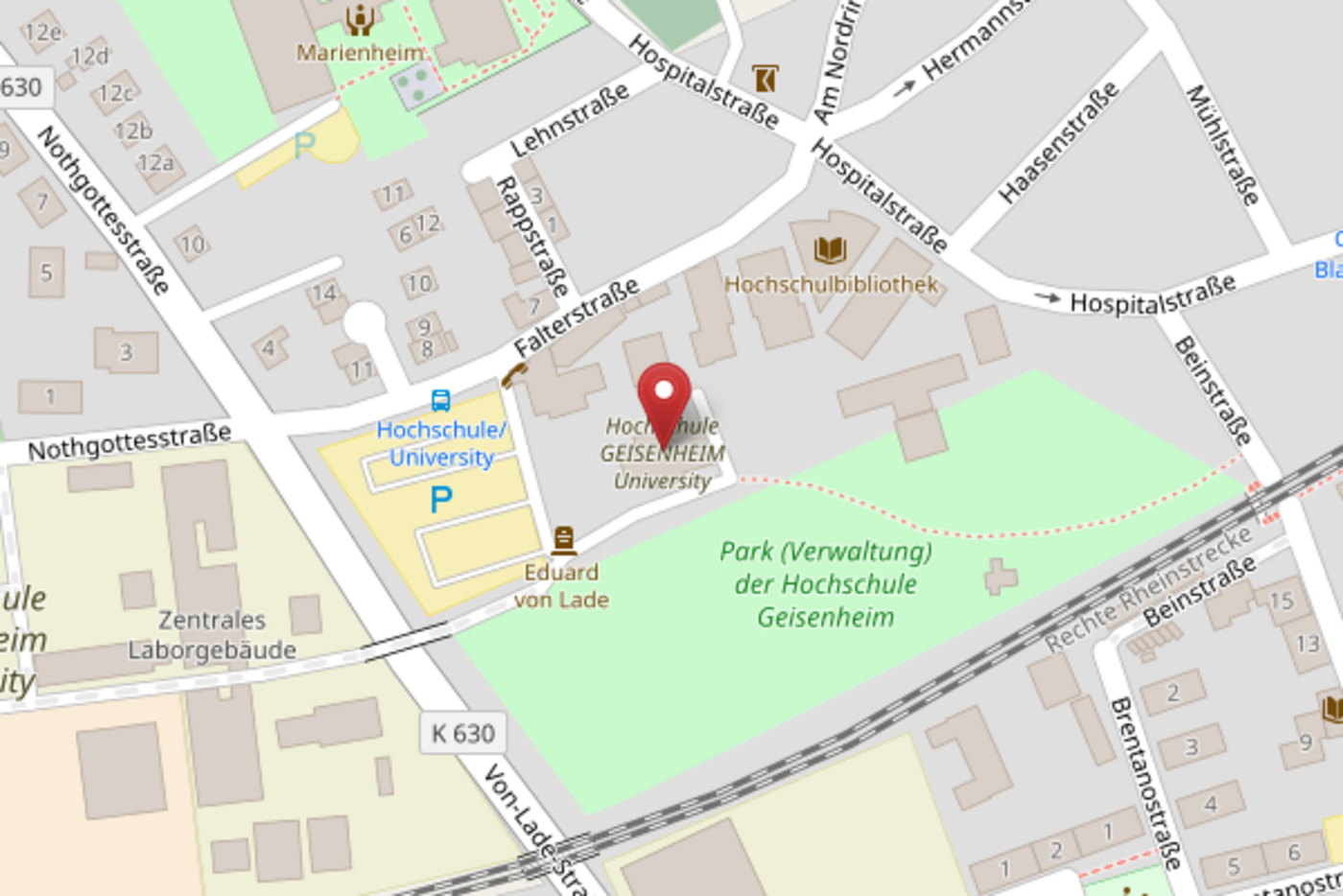
Anfahrt
duales Studium Gartenbau | Gartenbau Studium | Lebensmittelrecht Studium | Lebensmittelsicherheit Studium | Naturschutz Studium | Oenologie Studium | Studiengang Logistik | Studiengänge Lebensmittel | Studiengänge Natur | Studiengänge Umweltschutz | Studium angewandte Biologie | Studium Hessen | Studium Landschaftsarchitektur | Studium Lebensmittel | Studium Lebensmittelsicherheit | Studium Logistik | Studium Natur | Studium Naturschutz | Studium Umweltschutz | Studium Wiesbaden |