
Parks & Open Spaces

Green campus Geisenheim

The Geisenheim university location has a lot to offer when it comes to greenery. In addition to the numerous courses on the subject of plants and green structures, the campus offers a wide range of green topics with its two historical parks and many planted areas.

Planning, development and maintenance of the outdoor facilities

The outdoor facilities at Geisenheim University are subject to different areas of competence. The management of park maintenance from the area of ​​competence of the Plant Use Professorship has an overview of most of the green areas and the parks. It surveys the green developments on the university campus and tries to bring them together in a meaningful way. Individual projects and general maintenance are then taken over by the park maintenance team, provided capacity permits. Larger projects or more specialist tasks, such as regular tree inspections and tree care measures, are also outsourced. In addition to these general topics, the various study areas also manage some of their own projects, research areas and areas of competence on the topic of green.

Head of park maintenance team

Manfred Müller
Manfred Müller
Building 6701
Room 019
Phone +49 6722 502 543
Manfred.Mueller(at)hs-gm.de Details

Park maintenance team

Martina Brendel
Martina Brendel
Building 6701
Room 019
Phone +49 6722 502 543
Martina.Brendel(at)hs-gm.de Details
Jochen Lüdcke
Jochen Lüdcke
Building 6701
Room 019
Phone +49 6722 502 543
Jochen.Luedcke(at)hs-gm.de Details

management of park maintenance

Alexander von Birgelen
Prof. Dr. Alexander von Birgelen
Building 6701
Room 107
Phone +49 6722 502 773
Alexander.Birgelen(at)hs-gm.de Details
Campus with history

The historic parks Monrepospark on the South Campus and Rudolf-Goethe-Park on the North Campus are defining elements and deeply linked to the roots of the Geisenheim university location. Over time, a diverse and old tree population has developed there. The park and the trees it contains, like many of the university's buildings, are listed buildings. But here too, the effects of climate change are increasingly becoming apparent. Once very favorable in terms of climate, the mild warmth develops into summer heat. The Mediterranean-like climate develops persistent dry phases. The future of the university parks must now be well thought out and precisely planned so that the old trees can be largely preserved, renovated in a way that is compatible with monuments and the climate, and developed in a resilient manner.


An exciting task.


More about the history of the parks can be found on the following pages.

Beds & Plantings

There are beds and plantings of various ages throughout campus. As diverse as the choice of plants can be, the function of green elements is just as diverse. Plantings can separate or connect the room through their spatial effect. A certain character or atmosphere can be created with flowers, colors, structures and textures. Plants shape the space with their liveliness and also with their ecological benefits when people and animals benefit from them.


The skills of planning with plants are discussed and addressed in various subjects. The Plant Use Professorship has fully embraced this topic. She develops existing and designs new green elements on the grounds of Geisenheim University. Many beds are also used for teaching and are designed as display beds.

Professorship of Planting Design

Alexander von Birgelen
Prof. Dr. Alexander von Birgelen
Building 6701
Room 107
Phone +49 6722 502 773
Alexander.Birgelen(at)hs-gm.de Details
Habitat trees - old wood, new life

The university location is committed to preserving old, special habitat trees. Of course, parks should be attractive, vital and well maintained. Dying or already dead trees apparently do not belong in the picture. But these old "habitat trees" offer a particularly large amount of living space for a wide variety of creatures - from birds and bats that nest in tree hollows to special species of beetles that appropriate the wood. The decomposition processes may limit the stability of habitat trees and dead wood and are therefore particularly carefully monitored and checked. But not all habitat trees are dying or are already dead wood.


Healthy trees can also provide special habitats - which is why there are habitat trees in the park that have been awarded a plaque. The most important examples are explained here.

Competence Area Tree Nursery & Woody Physiology

Jörg Kunz
Dr. Jörg Kunz
Building 1000
Room 318
Phone +49 6722 502 538
Joerg.Kunz(at)hs-gm.de Details

PLANTINGS

The central campus is located to the east above the railway line. In addition to the historic Rudolf Goethe Park, important green structures here are often representative beds and edge plants.

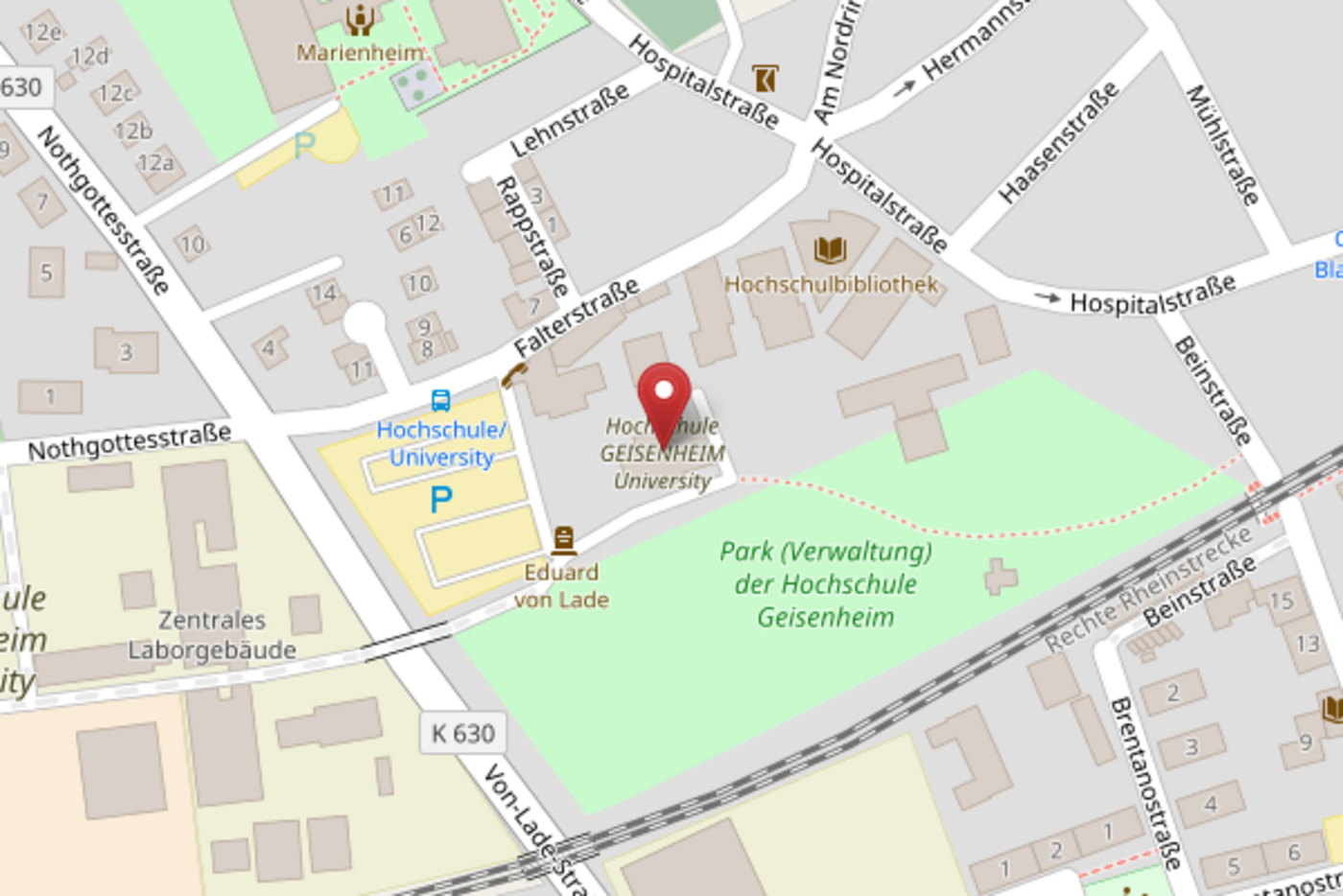
The southern campus is below the railway line and is essentially characterized by the historic Monrepospark and its beds.


More about the Professorship for Planting Design

News

20th Rhine-Main Municipal Tree Maintenance Conference at Hochschule Geisenheim University: Urban Trees and Climate Change

The conference of the Rhine-Main working group on municipal tree maintenance, which was established in 2000 and has been the recipient of substantial support from Hochschule Geisenheim University since 2014, fosters communication and networking between the fields of science and practice. In this anniversary year, its discussions revolved around the topic of young trees.

Thanks to their filter function and cooling effects, trees contribute signficantly to improving the microclimate in towns and cities and for this reason, their importance will only grow amid ongoing climate change. In this context, rising temperatures together with the increasing densification of cities create huge challenges for the trees themselves. "Today, urban spaces have become simply too warm for many species of trees that were considered suitable for towns and cities only a few decades ago," explained Professor Alexander von Birgelen, Professor for Planting Design at Hochschule Geisenheim University. What is more, the warmer climate and severe precipitation events expose trees to infestations of new types of pests and fungi.

With this mind, the 20th Rhine-Main Municipal Tree Maintenance Conference which took place at Hochschule Geisenheim University at the end of September 2019 centred on the topic of young trees. The focus was on the key issues that concern all municipalities: which trees should we grow in our towns and cities today? What are the basic urban conditions that we need to provide for them? How can we improve locations in order to sustain current stocks in the longer term?

As part of the anniversary conference, the speakers provided insights into the production of tree nurseries and wood inspections, reported on the integration of tree substrates and demonstrated skilled pruning techniques. Moreover, the approximately 90 participants discussed the application of professional standards and the new supplementary technical contractual requirements and guidelines for tree maintenance (ZTV). Representatives of the "500 trees for Rodgau" project showed how successful expanding urban tree stocks can be.

"In this context, networking at the regional level is of particular importance – now more than ever," said Dipl. Ing. Matthias Zorn, initiator of the Rhine-Main municipal tree maintenance working group and alumnus of Hochschule Geisenheim University. The Rhine-Main region is characterised by a largely uniform climate and is the warmest climatic region in Germany after the Rhine Rift Valley. "Therefore, every municipality in the region is struggling with the same issues brought about by climate change. These rapid changes mean that we have to make scientific evidence applicable directly in practice and discuss solutions together so that we can implement specific measures as quickly as possible," added Dipl.-Ing. Sylvio Jäckel, Head of Green Space Planning and Tree Management at the Dienstleistungsbetrieb Dreieich und Neu-Isenburg public service company.

The history of how the annual conference came into existences also demonstrates that there is a need for a relevant discussion and networking platform. Zorn set up the Rhine-Main municipal tree maintenance working group in 1999 and its numbers have grown steadily since then. At Zorn's instigation, Hochschule Geisenheim University came onboard five years ago as a "cooperation partner with the relevant expertise, organizational capacity and the right venue", and since then the working group has been provided with substantial support by the Geisenheim Institute of Continuing Education in organizing the conference and accompanying exhibition.

With its combination of scientific and practical presentations on the challenges facing the region, together with the Rhine-Main Tree Forum in Kriftel, the conference has become one of the two main communication platforms addressing the the complexities of "trees in urban spaces" in the Rhine-Main metropolitan area.


Categories: STUDIUM, UMSB (M.Eng.), Landschaftsarchitektur (M.Sc.), Weiterbildung und Career Service, Urbanen Gartenbau, Nachrichten

Archive

20th Rhine-Main Municipal Tree Maintenance Conference at Hochschule Geisenheim University: Urban Trees and Climate Change

The conference of the Rhine-Main working group on municipal tree maintenance, which was established in 2000 and has been the recipient of substantial support from Hochschule Geisenheim University since 2014, fosters communication and networking between the fields of science and practice. In this anniversary year, its discussions revolved around the topic of young trees.

Thanks to their filter function and cooling effects, trees contribute signficantly to improving the microclimate in towns and cities and for this reason, their importance will only grow amid ongoing climate change. In this context, rising temperatures together with the increasing densification of cities create huge challenges for the trees themselves. "Today, urban spaces have become simply too warm for many species of trees that were considered suitable for towns and cities only a few decades ago," explained Professor Alexander von Birgelen, Professor for Planting Design at Hochschule Geisenheim University. What is more, the warmer climate and severe precipitation events expose trees to infestations of new types of pests and fungi.

With this mind, the 20th Rhine-Main Municipal Tree Maintenance Conference which took place at Hochschule Geisenheim University at the end of September 2019 centred on the topic of young trees. The focus was on the key issues that concern all municipalities: which trees should we grow in our towns and cities today? What are the basic urban conditions that we need to provide for them? How can we improve locations in order to sustain current stocks in the longer term?

As part of the anniversary conference, the speakers provided insights into the production of tree nurseries and wood inspections, reported on the integration of tree substrates and demonstrated skilled pruning techniques. Moreover, the approximately 90 participants discussed the application of professional standards and the new supplementary technical contractual requirements and guidelines for tree maintenance (ZTV). Representatives of the "500 trees for Rodgau" project showed how successful expanding urban tree stocks can be.

"In this context, networking at the regional level is of particular importance – now more than ever," said Dipl. Ing. Matthias Zorn, initiator of the Rhine-Main municipal tree maintenance working group and alumnus of Hochschule Geisenheim University. The Rhine-Main region is characterised by a largely uniform climate and is the warmest climatic region in Germany after the Rhine Rift Valley. "Therefore, every municipality in the region is struggling with the same issues brought about by climate change. These rapid changes mean that we have to make scientific evidence applicable directly in practice and discuss solutions together so that we can implement specific measures as quickly as possible," added Dipl.-Ing. Sylvio Jäckel, Head of Green Space Planning and Tree Management at the Dienstleistungsbetrieb Dreieich und Neu-Isenburg public service company.

The history of how the annual conference came into existences also demonstrates that there is a need for a relevant discussion and networking platform. Zorn set up the Rhine-Main municipal tree maintenance working group in 1999 and its numbers have grown steadily since then. At Zorn's instigation, Hochschule Geisenheim University came onboard five years ago as a "cooperation partner with the relevant expertise, organizational capacity and the right venue", and since then the working group has been provided with substantial support by the Geisenheim Institute of Continuing Education in organizing the conference and accompanying exhibition.

With its combination of scientific and practical presentations on the challenges facing the region, together with the Rhine-Main Tree Forum in Kriftel, the conference has become one of the two main communication platforms addressing the the complexities of "trees in urban spaces" in the Rhine-Main metropolitan area.

Categories: STUDIUM, UMSB (M.Eng.), Landschaftsarchitektur (M.Sc.), Weiterbildung und Career Service, Urbanen Gartenbau, Nachrichten

Do you already know PLANT.ed?

PLANT.ed is a learning platform of the Professorship for planting design and represents a first point of contact for students who want to deal with planting design and planning. When looking for suitable information on these topics, one can quickly "get lost" in the "shoals" of an as yet undefined quantity and variety. On the one hand, PLANT.ed is intended to help with orientation in the subject area and, on the other hand, to support the teaching content of the various lectures and seminars. PLANT.ed is located on the ILIAS learning platform of Hochschule Geisenheim University and can be viewed by students and employees of HGU at any time.