Sustainability – What exactly does it mean?
The Department of Strategic University Development and Sustainability supports Hochschule Geisenheim University on its path towards becoming a sustainable and future-proof institution. But what does that mean exactly?
Our definition of sustainability is based on a number of key guiding principles and theories. These include the 1987 Brundtland Report, the integrative model of sustainability, the UN Sustainable Development Goals, Education for Sustainable Development, and the Whole Institution Approach.
The full title of the so-called Brundtland Report is ‘Our Common Future: The Brundtland Report of the World Commission on Environment and Development’. It was the result of the work of the Brundtland Commission, also known as the World Commission on Environment and Development (UN). The abbreviation is named after its then chair and former Norwegian Minister for the Environment, Gro Harlem Brundtland.
The report defined the concept of sustainable development for the first time as “development that meets the needs of the present without compromising the ability of future generations to meet their own needs.” This statement is vital to how we define sustainability..
The integrative model of sustainability, in turn, is one of many models that breaks sustainability down into specific dimensions relevant to everyday operations. This integrative approach supports our work because its core areas also drive our university's mission: something is considered sustainable if it can be implemented within planetary boundaries (ecology), in a socially just manner (social) and in an economically efficient way (economy).
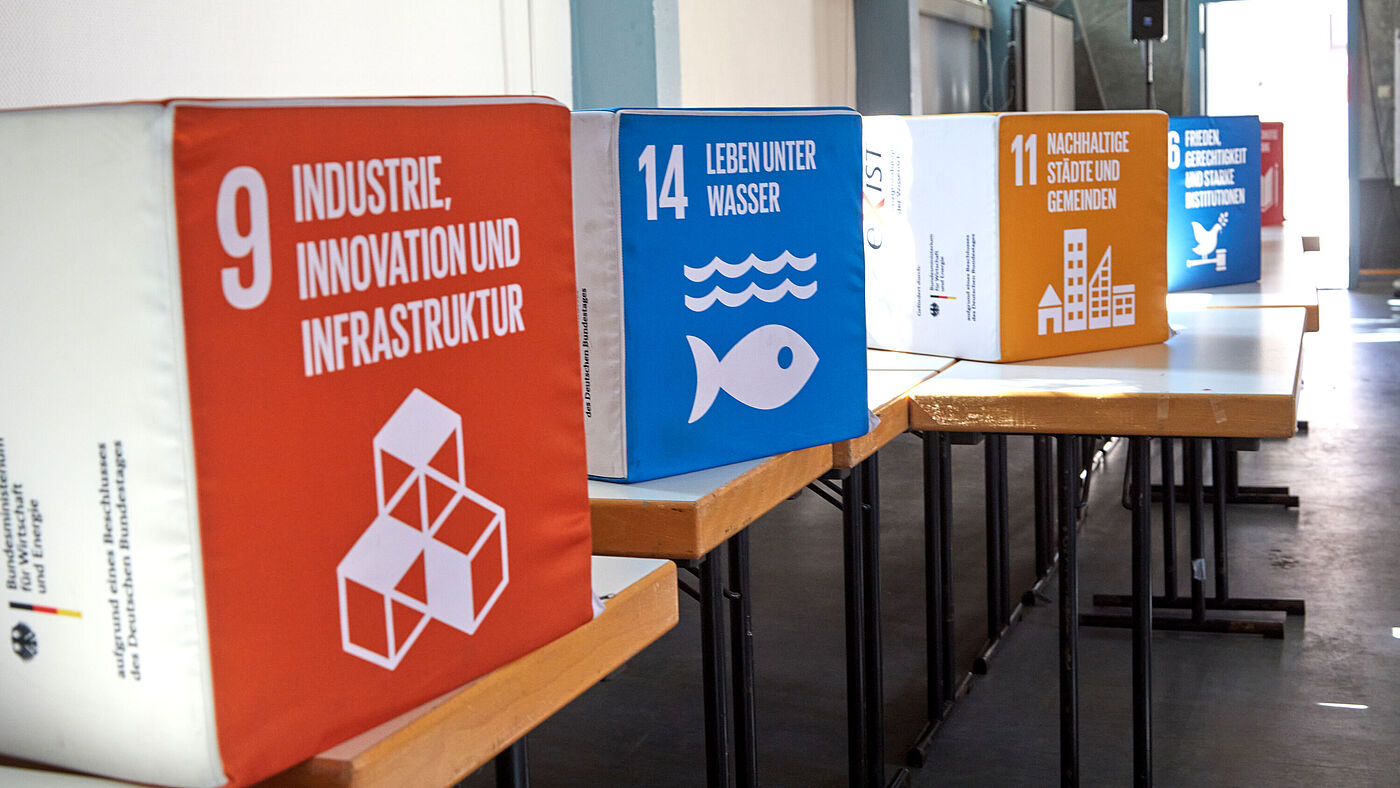
Furthermore, these three dimensions also play an important role in the 2030 Agenda for Sustainable Development. This strategy, adopted at the UN Sustainable Development Summit in 2015, represents a milestone in international cooperation. It sets out the 17 Sustainable Development Goals (SDGs), which, with their many sub-goals and time-bound measures, form the guiding principles for sustainable development worldwide.
The focus is not just on ‘ecological’ aspects that are often associated with sustainability. To build healthy ecosystems and fair societies, we need more than greening concepts and resilient city trees. Those things matter, of course, but long-term and sustainable prosperity requires deeper change.
However, the SDGs broaden the scope of areas relevant to sustainable development as they include issues such as poverty and prosperity, quality education, gender equality, affordable energy, peace and justice, and many more.
Furthermore, the department's work and the university's overall mission are guided by ESD – Education for Sustainable Development. This UNESCO educational concept aims to ensure that every individual understands how their own actions affect the world because once we understand the impact of our actions, we can make responsible, sustainable decisions.
All of that sounds like a huge task, so how can such a complex mission be implemented at a university? This is where the Whole Institution Approach comes into play, which has been established as a holistic ESD approach for higher education institutions. It identifies and describes specific areas that are relevant to educational institutions. It helps to set targets and assess if desired outcomes are achieved. In addition, the Whole Institution Approach defines sustainability not just as an individual project, but as a transformation process.
When an institution adopts the Whole Institution Approach, ESD becomes more than just a topic discussed in class. It means that teaching methods will also be designed with sustainability in mind. Furthermore, the institution will raise awareness among students and staff about the conscious use of energy and resources, and empowers them to make sustainable choices. It will provide relevant professional development opportunities for teaching and administrative staff and involve all members of the university community in the decision-making process.
At Hochschule Geisenheim University, sustainability is a key factor in the following areas: governance, operations, teaching, research and transfer. This means that sustainability is integrated into all of the university’s processes and activities:
Governance – includes the way decisions are made and implemented within an administration
Operations – refers to the day-to-day functioning of the university in terms of energy consumption, mobility, resources, and procurement
Teaching – addresses not only the content of lectures but also the provision of learning spaces and the design of the campus
Research – refers to the content of the topics and questions being researched, as well as the equipment and use of laboratories
Transfer – involves sharing sustainable principles and collaborating with aligned partners, including municipalities, regional manufacturers, and other universities
Get involved!
Sustainability thrives on active participation. Students and staff are invited to get involved by contributing their time, ideas and projects.
How to get involved:
- Workshops
- Dialogue events
- Ideas forums
- Project participation
- Networking meetings
- Teaching and practical projects
Feel free to get in touch: nachhaltigkeit[@]hs-gm.de!

Our scope of tasks
Strategic university development lays the foundations for a sustainable university. The department oversees development processes, supports decision-making structures and coordinates key sustainability and transformation initiatives.
Key Areas
- Strategic university development
- Support for committees and governance processes
- Sustainability governance and institutional embedding
- Reporting and monitoring
- Participation in alliances and networks
- Development and implementation of sustainability strategies
Our contribution
We create transparent processes, promote collaboration and support the university in embedding sustainability strategically and institutionally.
Sustainability in university operations means using resources responsibly and gradually developing the campus in a climate-friendly manner.
Key areas
- Energy management
- Monitoring of energy, water and waste
- Climate pathway and carbon footprint assessment
- Circular economy and resource efficiency
- Sustainable procurement
- Interface with building and property management and other operational areas
Our contribution
We support the university in reducing its environmental footprint and establishing sustainable operational processes on a long-term basis.
Hochschule Geisenheim University regards sustainability as part of its educational mission. The department promotes Education for Sustainable Development (ESD) in its study programmes and teaching, and continues to develop the campus as a vibrant space for learning and experience. The campus is increasingly seen as a real-world laboratory – a place where sustainable solutions are tested, reflected upon and further developed collaboratively.
Key areas
- Integration of ESD into curricula
- Professional development and advisory support for teaching staff
- Supervision of teaching and practical projects
- Coordination of the campus as a real-world laboratory
- Networking with degree programmes and academic departments
- Promotion of innovative learning spaces and participatory formats
Our contribution
We promote innovative teaching formats, interdisciplinary learning and practical sustainability skills.
Sustainable University development thrives on exchange. The Department promotes dialogue, networking and engagement both within the University and with external partners. In doing so, we create spaces for collaboration, visibility and shared commitment.
Key areas
- Networks and collaborations
- Event and dialogue formats
- Participation processes and opportunities for involvement
- Public relations
- Internal communication
- Raising the profile of sustainability activities
Our contribution
We strengthen University-wide exchange and foster an active culture of sustainability.