QSL projects "Nachhaltiges Reststoffmanagement" (Sustainable waste management) & "G-wurmt"
From kitchen waste to compost
The collection of organic residues continues!
Without you this would not be possible – so we would like to thank you for the joint composting success! Now we are expanding our field of action and are looking forward to your further participation.
WHAT, WHY & HOW
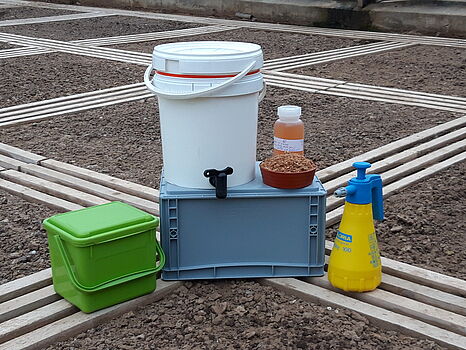
We collect our organic kitchen waste and process it into compost ourselves on site. In part (as before) via the preservative intermediate step “Bokashi”, then in managed compost heaps – and in part (ALL NEW from March 2025!) directly into fresh worm compost.
In this way, we have recently been killing three birds with one stone: we are reducing the amount of our residual waste in order to generate valuable substrate/fertile soil from these valuable raw materials instead, and we are also trying out different methods. Our goal is to make the knowledge gained in this way available in a transparent manner.
Compost heaps take quite a long time from setting up to completion of the conversion, so they are only reset at longer intervals and then require a lot of nitrogen-rich material at once. However, nitrogen-rich material – such as kitchen waste – only accumulates in small quantities over time and then spoils just as quickly, as everyone knows from their own kitchen. It therefore makes sense to preserve kitchen waste – by fermentation (bokashi) – as an intermediate step.
Only compost worms are even quicker...
…because not only can food waste be fermented, but it can also be a valuable food source for compost worms. During vermicomposting, the locked-up nutrients in food waste are converted to plant-accessible forms by enzymes and microbes present in the worms’ guts. After about 1-2 months, the compost is ready. It is a homogenous and stable product. The compost can be added as a fertilizer to soil or substrate, or using non-saline water, brewed into compost tea (worm tea), a liquid fertilizer that can be watered or applied to leaves.
Worm compost has many positive properties, among them:
- an increase in organic matter,
- an increase in microbial activity,
- an improved water-holding capacity and soil structure,
- and of course, the fertilizing effect.
- We provide each institute with:
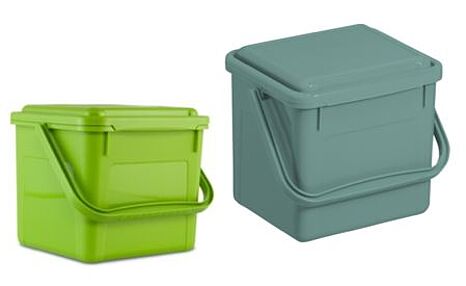
- 2 kitchen waste buckets with lids and
- Instructions: “Kitchen waste collection”
- Instructions: “What goes where and why”
- Please place your bucket #1 in an easily accessible, cool place in your institute (in the kitchen, e.g. near the coffee machine).
- Please collect in this bucket the organic waste,
- which accumulates during your working hours:
- in principle, everything that you would throw into a compost bin is fine to go in the kitchen waste bucket as well,
- however, larger quantities of orange peel, for example, are no problem either thanks to the fermentation process.
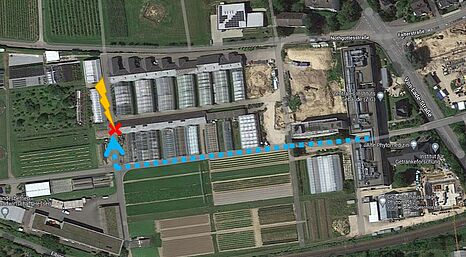
- Please bring your respective bucket twice a week to our drop-off station:
- Tuesday AND Friday
- UNTIL 13:30
- at the south connector of the greenhouses, west entrance (soil science)
- and take your (rinsed) bucket #2 directly there in exchange – with which you then proceed in the same way.
- We register your recyclables and process them and rinse your bucket for you.
- One part is fermented as Bokashi and then composted in large guided compost heaps,
- the other part is processed directly into fresh worm humus by very busy worms in 3 different worm composters.
Would you like to join us?
Are you and your colleagues also interested in
- in reducing the amount of residual waste at HGU and
- recycle valuable residual materials?
Then please send us an e-mail with the subject “Question about kitchen waste/Bokashi” to nachhaltigkeit(at)hs-gm.de.
How it started & where we are now - thanks to you!
As part of the “PC4Compensation” research project, the volume of soft biomass at the university was investigated. This had previously been disposed of in the residual waste for a fee, so the system had to be changed and guided aerobic heap composting was established. In addition to the treatment of the heap, its composition is critical for a high-quality composting result – the greatest possible heterogeneity of the components and an optimum C:N ratio of 25-30:1 are important here.
Green cuttings, such as those we receive from our park maintenance department, are very suitable as a source of C (carbon). These are “easy to care for” in the sense that they keep well under ambient conditions (oxygen, possibly high temperatures & humidity to wetness) without spoiling – we can simply store them outside until we prepare the next compost heap.
In addition to various types of manure, kitchen waste is a very good source of N (nitrogen). In contrast to the C-suppliers, however, these accumulate continuously but only in relatively small quantities and start to spoil very quickly under normal environmental conditions (as everyone knows from their own kitchen). It was therefore necessary to preserve them until they could be composted – the idea of bokashi production was born. The precious organic material is fermented using Effective Microorganisms (similar to the production of sauerkraut) and thus biologically stabilized (preserved) until it is used in composting.
the Department of Applied Ecology collected a total of over 300 kg of kitchen and coffee waste from four institute kitchens on the West Campus. This made it possible to recycle almost 9 kg of material per person per year, which would otherwise have ended up as residual waste.
The finished compost was used for experiments and on the institutes' grounds.
Now part of the Department for Strategic University Development and Sustainability, we resumed this campaign – also due to the positive response from the college – now with more staff and with all interested institutes and departments involved. Due to the increased volume, the pick-up system became a drop-off system (for example as a short digestive walk after lunch). Within 7 months, almost 500 kg of kitchen scraps were collected in this second round, which we turned into valuable compost instead of it ending up unused in the residual waste.
The finished compost was again used for experiments and on the areas of the institutes, and this time also by the neighboring LLH and to a small extent privately by students for the community garden and by employees of our university.
Would you like to benefit?
Are you interested in ready-to-use compost for your own garden?
Then please feel free to send us an e-mail with the subject “Interested in compost” to nachhaltigkeit(at)hs-gm.de.





Please note
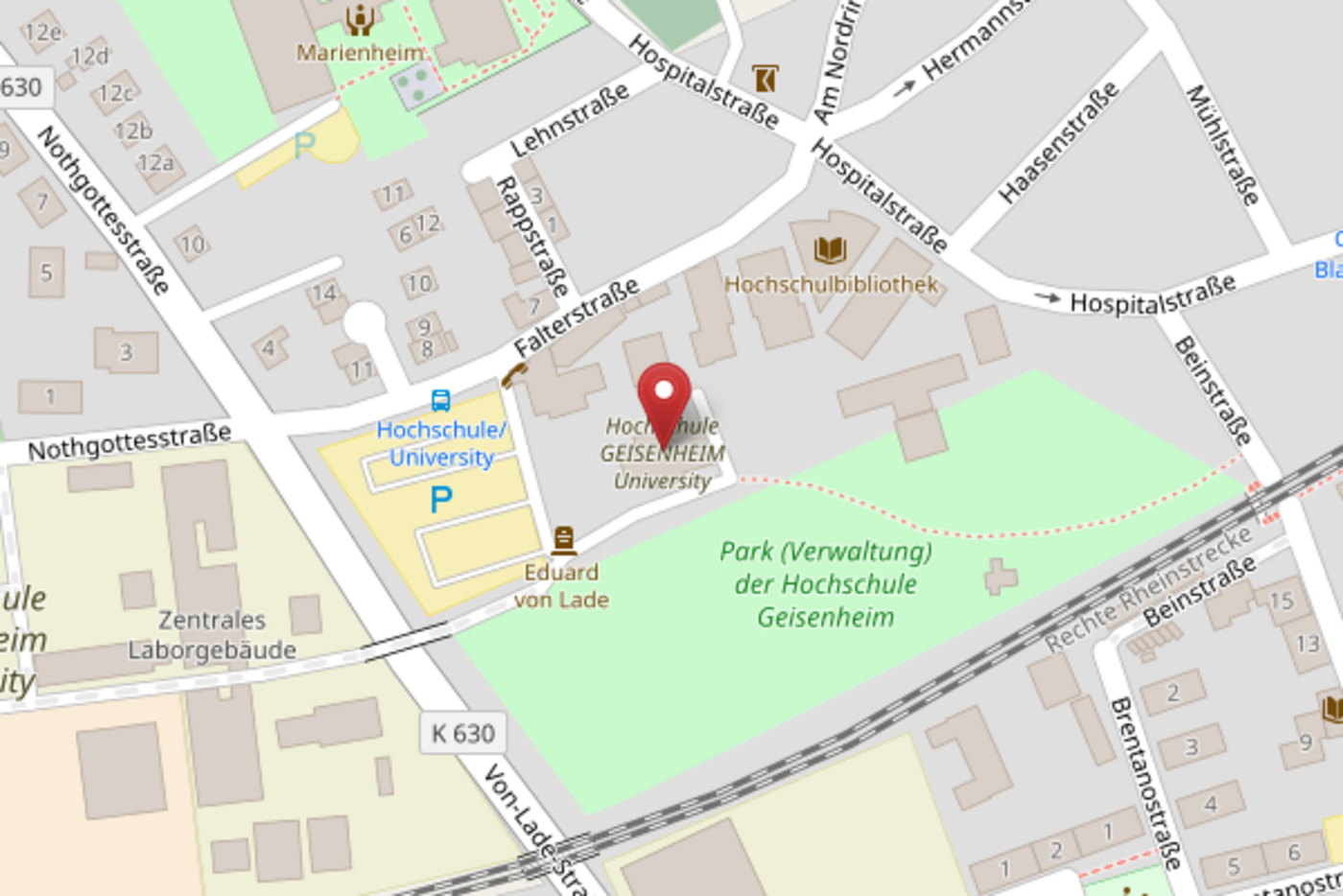
Due to construction at the administration building until further notice you will find us here:
Industriestraße 2 (Building 9002)
2nd floor, to the right/north
65366 Geisenheim