
Research at Hochschule Geisenheim University

Creating Strategies for a Sustainable and Livable Future

Climate Change, Biodiversity Loss, Sustainability Targets – We're Meeting the Planet's Most Urgent Challenges

Our mission is to develop resource-efficient, innovative, and sustainable solutions in the area of agriculture and food. Our work spans a broad range of key issues: advancing organic, climate-resilient cultivation strategies for specialty crops, developing sustainable production and marketing methods, and designing livable cultural landscapes and urban regions. By uniting ecology, profitability, and a focus on quality of life, we aim to create a sustainable future in which society and nature can flourish together.

Our Focus Areas

Sustainable Cultivation Systems for Specialty Crops

Cultivating grapevines, fruit, vegetables, and ornamentals is particularly resource intensive – as such, a careful balance between producing the highest quality products possible and ensuring sustainable practices needs to be struck.

Through our research, we are developing innovative, ecofriendly strategies that ensure healthy harvests and preserve resources. We breed varieties and growth forms that are optimally adapted to climate change, environmental factors, and potential pests and pathogens. Modern sensor systems help control water and nutrient supply with pinpoint accuracy, alternative plant protection strategies – such as the use of antagonists – strengthen plants and their environments, and new digital techniques make precise management measures possible. Together with our partners, we are establishing diverse cultivation strategies that promote biodiversity and preserve ecosystem functions, creating an economically and ecologically sustainable future for viticulture and horticulture.

Innovative and Safe Processing and Marketing for Plant Products

Sustainability in food production spans the entire journey, from cultivation and processing to the moment the product reaches the customer. At every stage, product quality and safety needs to be guaranteed. The bioeconomy plays a key role in this context, enabling the more efficient use of resources, processes, and systems, while supporting the livelihood of the businesses that produce them. 

Through our research, we develop energy and resource-efficient methodologies for processing plant products and extracting valuable ingredients from crops and by-products. We examine microorganisms as natural protective cultures, evaluate the health effects of plant-based ingredients, and conduct sensory tests with our university panel. Market research, consumer behavior analyses, and industry data deliver essential insights for sustainable marketing strategies, particularly in the wine industry. We also analyze the logistical processes, from packing to distribution, and boost the efficiency and sustainability of the entire value chain with the help of modern, digital technologies.

Livable Cultural Landscapes and Urban Regions

Intensified land use has reduced valuable landscape features and biodiversity in many areas. Urban regions are also under pressure to maintain quality of life through green infrastructure such as parks and green belts.

Through our research, we develop methods to optimize and assess urban open spaces and enhance their social sustainability. We create techniques for greening sites with limited soil and for using plants in urban areas in a targeted manner, particularly in the context of climate change. For viticultural landscapes, we design strategies to adapt to climate change and preserve rare species. Additionally, we develop concepts for multifunctional, ecologically valuable, and attractive landscapes that enable new, sustainable production scenarios.

Questions about Our Research?

Please get in touch!

Christiane Jost
Dr. Christiane Jost
Building 5924
Room 01.01
Phone +49 6722 502 6334
Christiane.Jost(at)hs-gm.de Details

News & Latest Projects

Draft Hessian Higher Education Pact 2026–2031: Universities Warn of Structural Underfunding

Photo: Torsten Silz

Translation of a press release co-authored by the leaders of Hessian universities.

The state government’s plans for the Higher Education Pact would lead to a deficit of around one billion euro at Hessian universities over the next six years and would result in a permanent ten percent reduction in the number of academic, artistic, and administrative employees. Universities in Hesse are demanding targeted amendments to the plan.

Last week, as part of the proceedings for determining the Hessian Higher Education Pact for the period from 2026 to 2031, the Hessian Minister of Science Timon Gremmels presented the first concrete numbers for the higher education budget to university leadership. Although the 14 state universities will face permanent increases in personnel costs of over 60 million euro per year in 2026, the budget for 2026 and 2027 is set to fall below the 2025 level during the transition to the new Higher Education Pact. The planned average annual increases of 2.12 percent per year compared to 2025, which will be scheduled to gradually take effect from 2028 onwards, will not offset this shortfall. Even if future wage agreements and inflation prove to be moderate in scope, Hessian universities are expecting a funding deficit of around one billion euro by the end of the Higher Education Pact in 2031. This equals a yearly deficit of around 167 million euro, or around ten percent of the universities’ personnel budgets. Since state funds will only be made available from 2028 whereas the increased costs will come into effect immediately, there is a time gap in the budget balance. This will make it more difficult for individual universities to ensure their liquidity under their own power. 

Inadequate Funding for Universities

The planned measures do not reflect the coalition agreement of the state government, which emphasized “adequate and sustainable funding” for Hesse’s higher education system. For the sake of the state’s future, education should be a first priority. 

“Even if we entered this new pact phase with no prior burden and could simply assume a continuously increasing budget, an average annual increase of 2.12 percent does not come close to offsetting the expected rise of personnel and administrative costs; it can only be regarded as a structural cut,” explains Professor Thomas Nauss, spokesperson for the conference for Hessian university leadership. “This cut has long-term implications: it threatens the ability of universities to conduct research, teaching, and outreach far beyond 2031.”

Universities Fear Unstructured Consolidation in Research and Teaching 

“The structural cut means that key, vital services for Hesse will be suspended,” adds Professor Karim Khakzar, spokesperson for Hessian Universities of Applied Science (HAW Hessen). “Even if universities immediately and completely stop hiring, thus risking a random and unstructured consolidation process, they still run the danger of structural deficits. In a situation like this, our goal of preserving and improving the functionality of Hesse’s higher education system is unattainable. There is a fear that individual research or teaching areas will have to be discontinued and staff cutbacks actively pursued.”

Professor Elmar Fulda, spokesperson for Hesse’s art colleges, adds: “The state government actually wants things to take off economically – but where is Hesse meant to find the trained, creative minds that can make that happen if not at its own universities and colleges? This planned contraction will have direct consequences for science and the arts, for teacher training, and for the entire range of disciplines, including the humanities, cultural and social sciences, natural and engineering sciences, life sciences, and medicine. This isn’t the way to secure skilled workers for the future.”

In the 2025 financial year, Hesse’s universities have already achieved a third of the state’s target saving goal by providing construction reserves amounting to 475 million euro. As such, the universities have demonstrated their responsibility and commitment to the state. They remain ready to look for possible solutions together with the state government to surmount the economic dip without harming the higher education system. 

“Hesse’s universities demand the preservation of the long-term functionality and competitiveness of the state’s higher education system and, as such, the safeguarding of Hesse as a beacon of science and creativity,” summarize the three spokespersons. “The universities in Hesse are expecting significant improvements to the planning of the Further Education Pact, both in terms of cost-neutral changes that serve the universities’ interests and targeted financial improvements.” To this end, the heads of the 14 universities in Hesse will be submitting a key issue paper to the Ministry of Science. 

Publisher: Marburg University Communications Department
Editing: Dr. Gabriele Neumann
Tel: 06421 28-23010
Fax: 06421 28-28903
E-mail: pressestelle@uni-marburg.de
Marburg, June 10, 2025

Categories: MyHGU-App, Top-News (intern), Mein-Netzwerk, Presse und Kommunikation, FORSCHUNG, Nachrichten

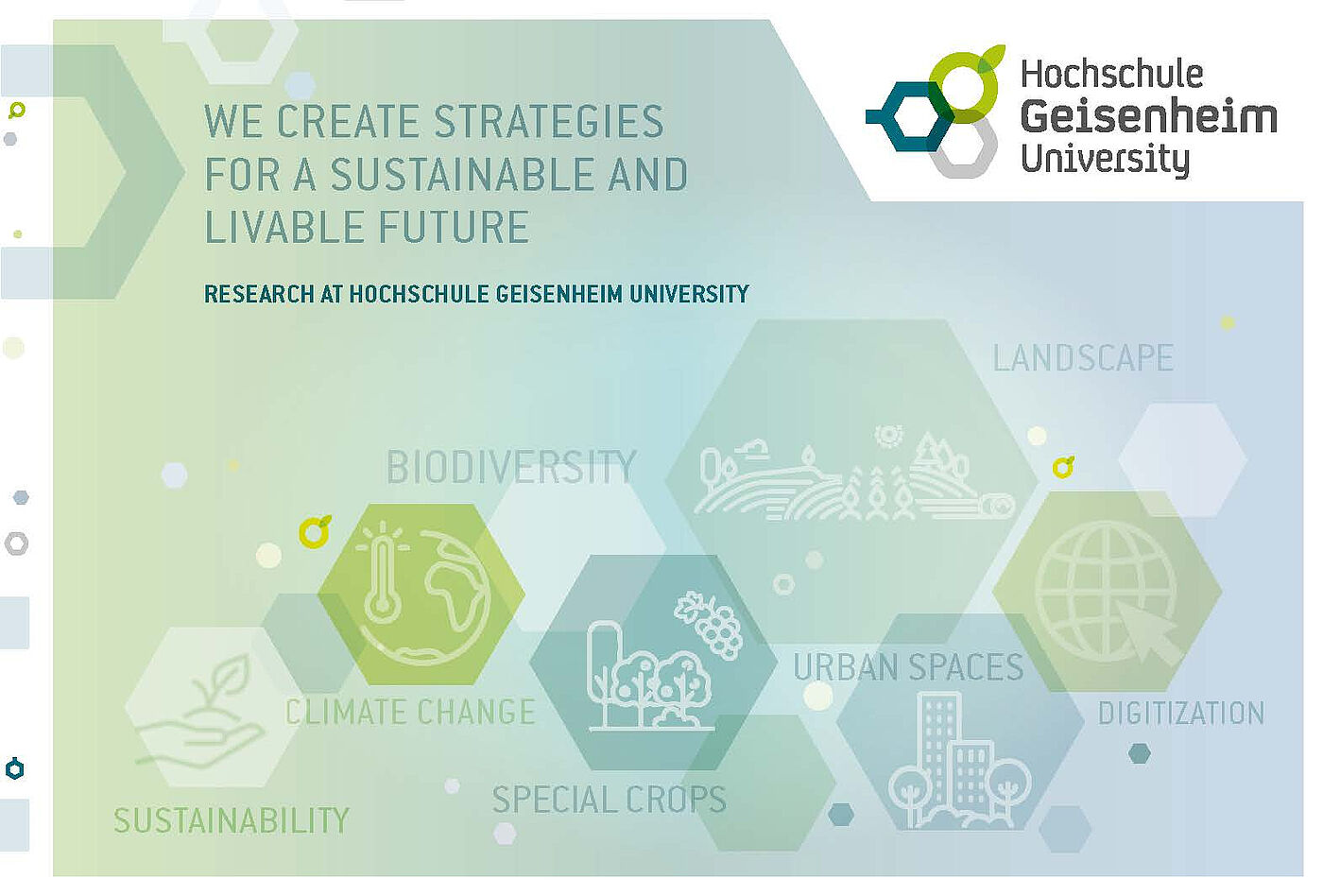
Research brochure (click to enlarge)

Our University has unique opportunities to conduct scientifically recognized and applied research along the entire value chain of special crops. In doing so, we benefit both from a strong network of national and international partners and our own excellent research infrastructure at Geisenheim. Vice-President of Research Professor Annette Reineke