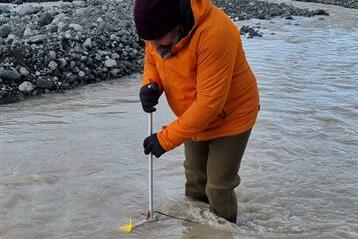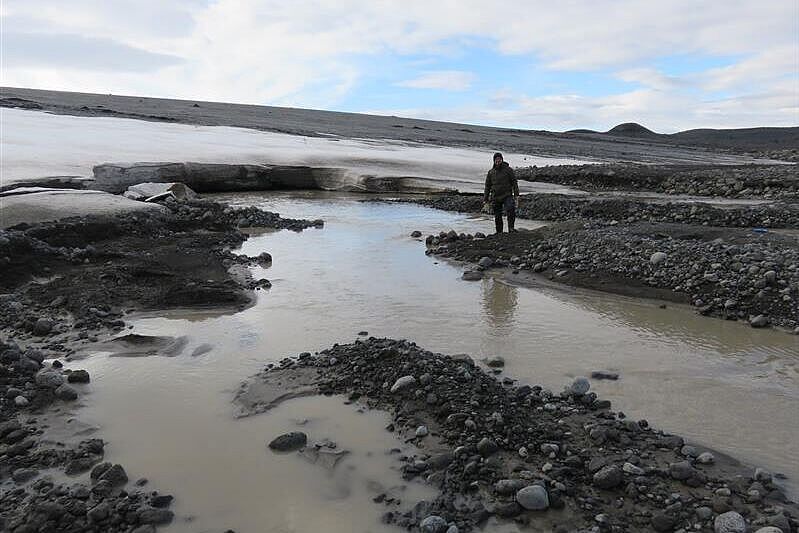
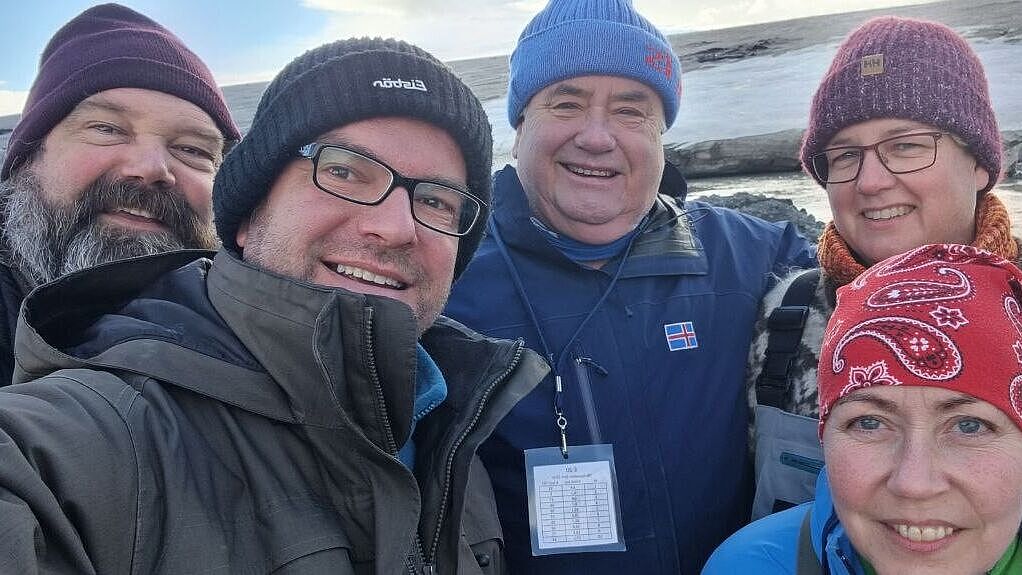
The volume of glaciers in Iceland (in 2019) corresponds to about 9 mm of the potential global sea level rise. With climate-related glacier melt, water temperature is set to increase and the hydrochemical balance will change. Scientists expect that large amounts of carbon will be released in the form of dissolved particles, affecting the living conditions of organisms and, consequently, the biodiversity of such stream ecosystems. However, the exact nature of these changes for glacier-fed streams in Iceland is largely unknown as there are hardly any comparative studies of Arctic glacial rivers to date. The Geisenheim scientist Dr. Martin Reiss was invited to join the European research project “Arctic & Alpine Stream Ecosystem Research” (AASER25). 26 years ago (from 1996-99) the AASER research network (University of Leeds, University of Birmingham, Norwegian Institute for Water Research, Science Museum Trento, University of Geneva, University of Iceland, Reykjavik) provided a basis for understanding how glaciers affect the biodiversity, hydrology, geomorphology, and water quality of rivers in eight European mountain regions. Now, a follow-up research project was carried out in the Icelandic river region Vestari-Jökulsá from September 20-23, 2022 to study the biodiversity, hydrology, geomorphology and water quality in the area. The team consisted of Prof. em. Dr. Gíslason (University of Iceland, Reykjavik), Ragnhildur Þ. Magnúsdóttir and Iris Hansen (Marine and Freshwater Research Institute, Reykjavik) as well as Prof. Dr. Chifflard (University of Marburg) and Dr. Martin Reiss (Hochschule Geisenheim University).
The Vestari-Jökulsá is an Arctic glacial river that originates from the Sátujökull outlet glacier, which is part of the Hofsjökull Ice Sheet. From the current glacier gate to the lowland, various sampling sites along the river were selected and examined in order to document the effects of glacier melt on downstream ecosystems, inform policy-makers and nature conservation groups, and contribute to future IPCC and IPBES reports. In addition, Dr. Martin Reiss was able to start with the pre-planning of a DFG-funded project which is carried out in cooperation with the University of Marburg (see: https://hs-gm.hessenfis.de/converis/portal/detail/Project/12116033) and organize the cooperation with the Marine and Freshwater Research Institute and the University of Iceland in Reykjavik.
Contact:
Dr. Martin Reiss
Department of Landscape Planning and Nature Conservation
Center Of Excellence, Cultivated Landscapes
Phone: +49 6722 502 654
Literature:
Aðalgeirsdóttir, G., Magnússon, E., Pálsson, F., Thorsteinsson, T., Belart, J. M., Jóhannesson, T.et al. (2020): Glacier changes in Iceland from∼ 1890 to 2019. Frontiers in Earth Science, 8, 523646. https://doi.org/10.3389/feart.2020.523646
Chifflard, P., Fasching, C., Reiss, M., Ditzel, L., Boodoo, K. S. (2019): Dissolved and particulate organic carbon in icelandic proglacial streams: a first estimate. Water, 11(4), 748. https://doi.org/10.3390/w11040748
Hugonnet, R., McNabb, R., Berthier, E. et al. (2021): Accelerated global glacier mass loss in the early twenty-first century. Nature 592, 726–731. https://doi.org/10.1038/s41586-021-03436-z