What EU-GIFT is all about

For Hochschule Geisenheim University (HGU), EU-GIFT means to move forward along a decidedly more international roadmap. As a member of the EU-GIFT alliance, we are setting off on a path towards a future European university.
This ‘European University for Geographical Identity as a driver for Food Systems Transition to Sustainability’ is a consortium of seven higher education institutions, all of which are exploring how in the long term, their respective regions and geographical identities can be strengthened through the creation of sustainable food systems.
The members are: Bordeaux Sciences Agro (France), the University of Agricultural Sciences and Veterinary Medicine in Cluj-Napoca (Romania), Eszterházy Károly Catholic University in Eger (Hungary), the University of La Rioja (Spain), the University of Trás-os-Montes and Douro (Portugal), the University of Verona (Italy) – and Geisenheim.
What is the purpose of the alliance?
The idea behind EU-GIFT is not simply that of a project limited to the fields of food science or viticulture in a rural region. Rather, it describes a broad, interdisciplinary initiative designed to include the entire community of a university: students, researchers, and service staff.
To achieve this ambitious goal, the focus is set on joint, cross-border activities in (digital) teaching, research and a continuous professional development, accompanied by an ongoing commitment to international collaboration and close cooperation with local and regional partners in business and society.
Beyond that, the initiative aims to pave the way for an inspiring exchange on lean and successful administrative processes as well as on how to establish higher standards in sustainability and inclusion.
A strong and vital connection between partner universities will foster new ideas and synergies, thus allowing for more innovative approaches to take shape.
Our EU-GIFT Team and Network
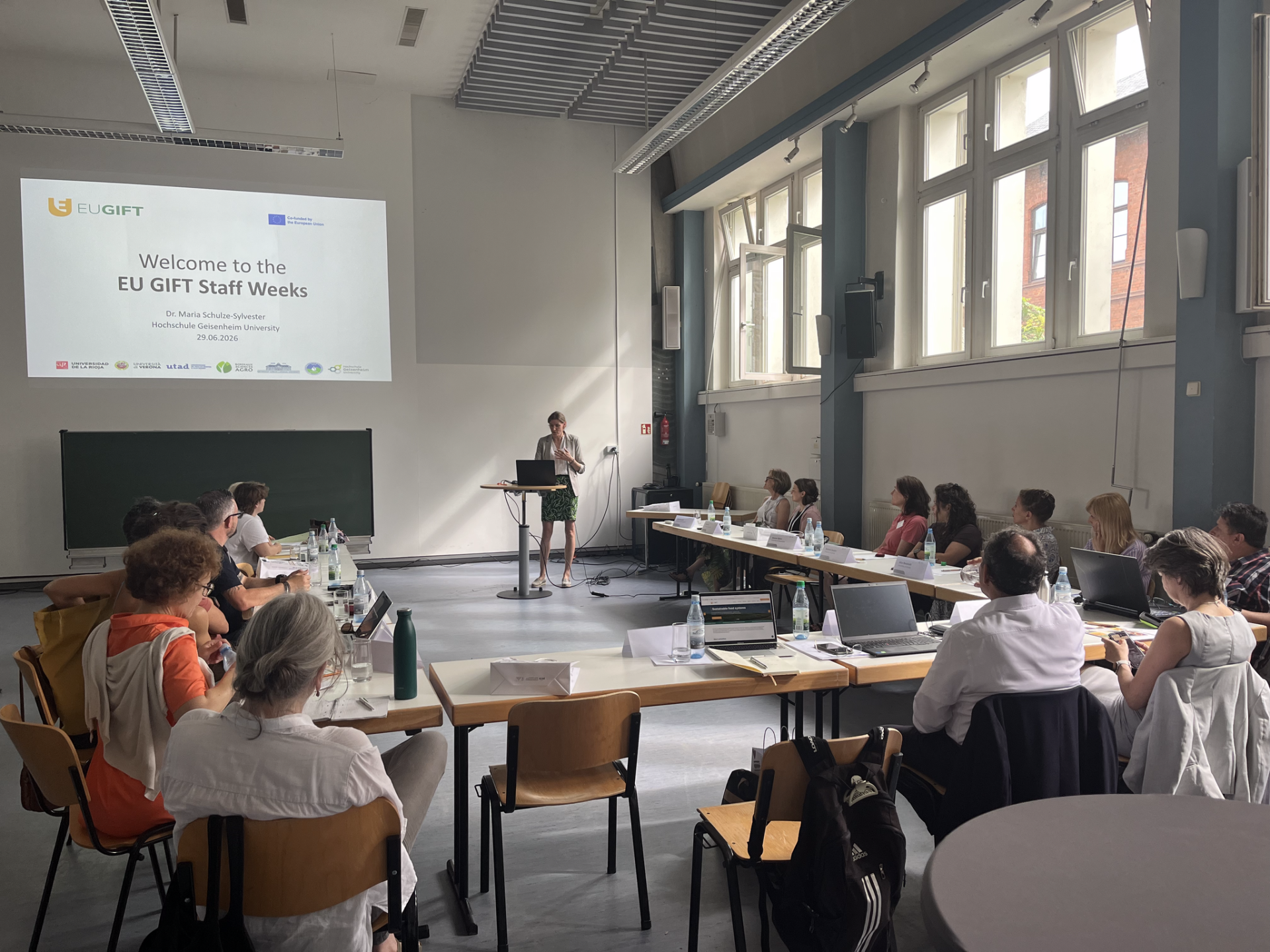
Given its significance for the entire university, the initiative has been established as an executive department and reports directly to the President. The department is headed by Prof. Dr Moritz Wagner as the representative of the Executive Board, whilst Dr Maria Schulze-Sylvester is responsible for the overall coordination. Both report regularly to the Executive Board and the Senate on developments and activities within the programme.
The allocation of tasks within the alliance is organized into a total of seven work packages. Every university acts as a ‘lead’ and is therefore responsible for one of the work packages, as well as taking the ‘co-lead’ for a second package. At Geisenheim University, we are responsible for Work Package 6, ‘Inclusion, Sustainability & Third Mission’, which is led by Larissa Urbanz.
Within the alliance, the strategic and operational management as well as quality assurance are carried out through a joint governance structure, in which the HGU Executive Board is also involved. In addition, an Advisory Board brings together companies from the region, students, alumni and other relevant internal and external stakeholders.

Past Events
Work Package Meeting
As a member of the EU-GIFT alliance, we are setting off on a path towards a future European university. What is important here: Europe is a Europe of regions. Cooperation at European level, closely linked with responsible action at local level, ensures strong and stable networks. Only together can we achieve the transformation of agriculture and secure the food of the future.