“In the first project semester, selected plants from Hochschule Geisenheim University were installed in large containers in the informatics building on Hochschule RheinMain’s Unter den Eichen campus. Equipped with a camera and sensors, the project’s aim was to record environmental parameters such as soil moisture, light and temperature, and use this information to develop a data-based irrigation and care concept”, explains Dr. Maren Stollberg from Hochschule Geisenheim University. The collected data was processed using a data management system that was specifically designed for this purpose, and formed the basis for a smart plant installation. A microcontroller recorded the sensor data and transmitted it to the HSRM server. For better visualization, all information was displayed on an e-paper and on a project website developed by Media Management students.
In a next step, the sustainable plant container was fine-tuned both conceptually and technically. "The sensor data flows into an AI model based on open-source technology that evaluates the plants’ condition and recommends necessary steps," outlines Professor Holger Hünemohr from HSRM’s Business Informatics program.
Meanwhile, the plant container is installed in the L Building on Kurt-Schumacher-Ring Campus, where it improves the microclimate and quality of time spent in the building. The Media Management students are responsible for project communication, developing a project website with live data and AI visualization, and documenting the project on film and social media with the aim to spark interest in sustainable, technology-driven solutions that align with global sustainability goals.
Smart division of tasks for joint success
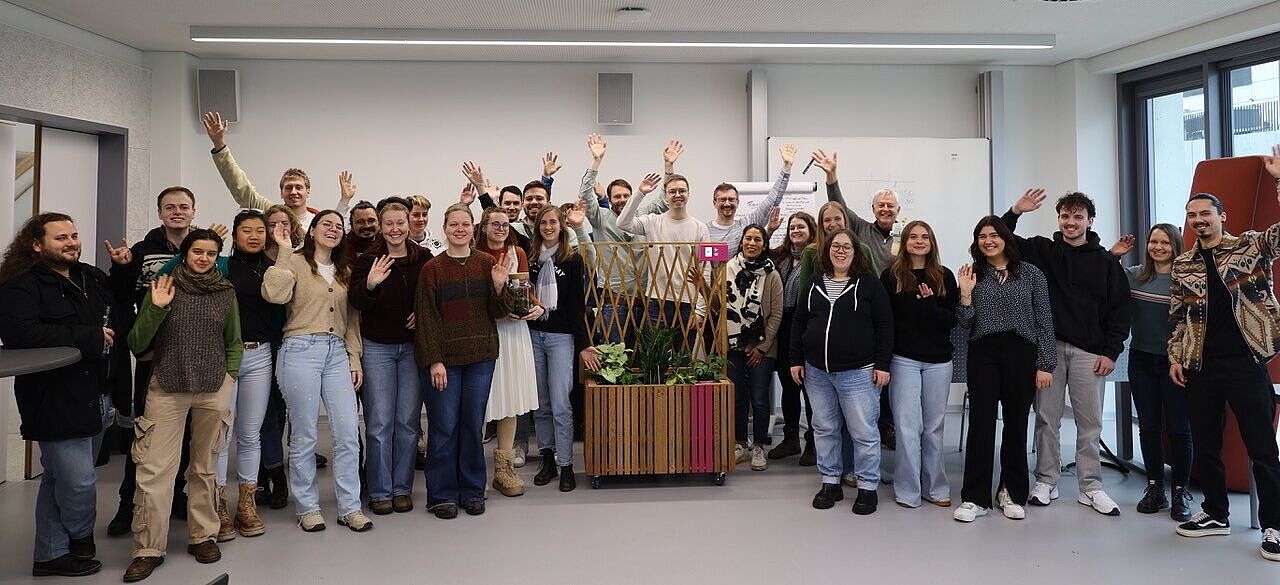
Throughout project, the two universities have cooperated closely, with each adding its individual strengths to the project: Hochschule Geisenheim University was responsible for developing horticultural concepts while Computer Science students took care of the IT infrastructure for data collection and analysis. The Media Management students designed the communication and multimedia presentation of the project. “This project is a prime example of how technological solutions and scientific analysis can be combined with creative communication to develop sustainable studying and working environments”, explains Prof. Dr. Johannes Luderschmidt from the Media Management program.
Future of the project in interior architecture
In the upcoming summer semester, the results of the SNIB project will be taken up in the living materials lab of HSRM’s Interior Architecture program and integrated into an experiential materials library for regenerative interior design. In this context, material and plant systems will be optimized with sensor technology and AI-powered monitoring systems with the aim to measure the quality of indoor areas and to use the plant system as a basis for green design approaches.
More information: snib-hsrm-hgu.de