

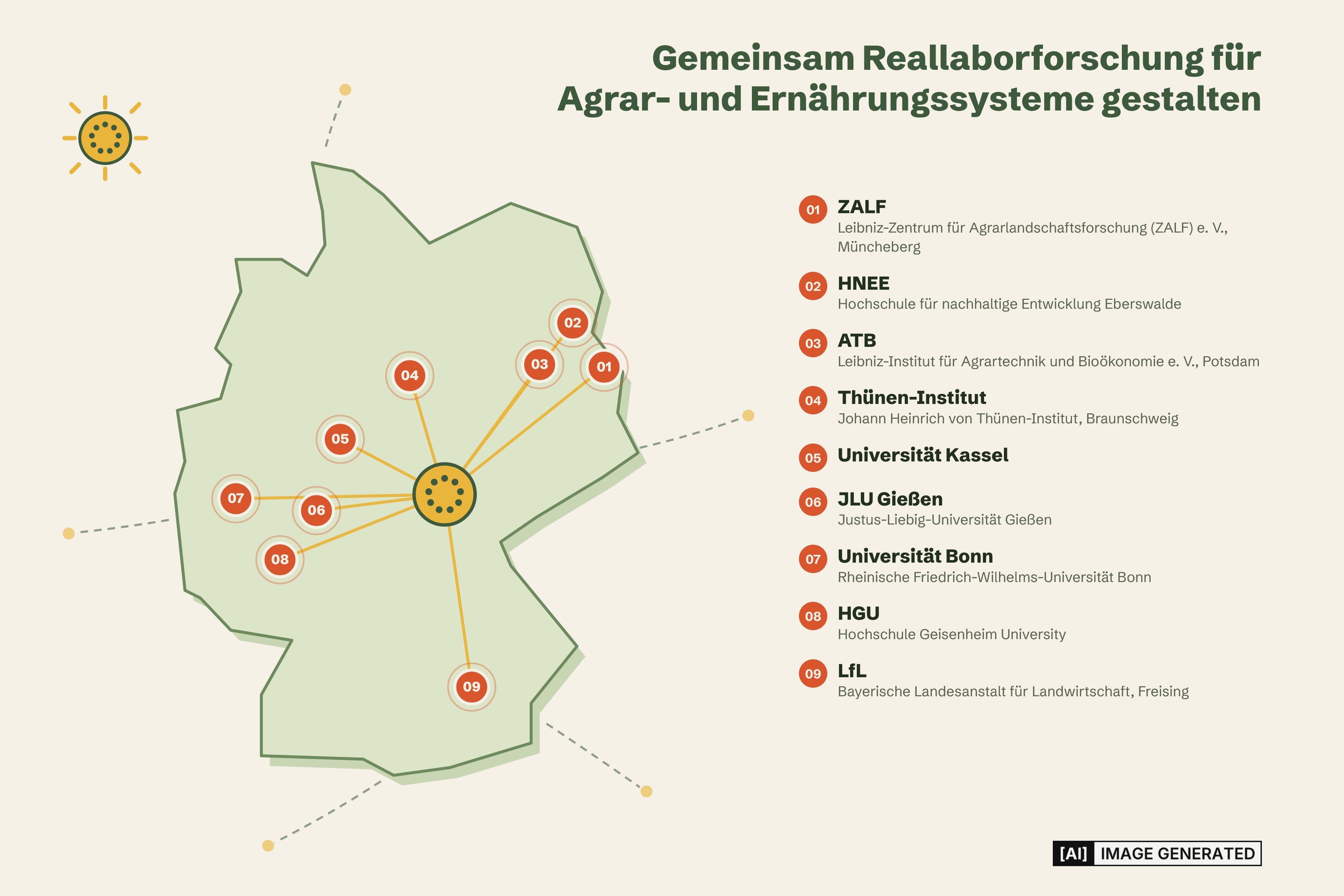
How can living lab research be structured to effectively contribute to the long-term transformation of agricultural and food systems? In order to share experience and expertise more effectively in this rapidly expanding research field, nine institutions have signed a memorandum of understanding to establish a nationwide alliance for living lab research in agriculture and food systems. The participating institutions presented the joint initiative on September 24 at an event organized by the Innovation Centre for Agricultural System Transformations (IAT) in Giessen. The alliance is expected to be formally established before the end of the year.
This strategic coalition will invest in the development of Living Labs as innovative research infrastructures, bring together insights on research in and about Living Labs, advance research jointly, and strengthen suitable structural frameworks for Living Labs as research infrastructures. The alliance is initiated by the Leibniz Centre for Agricultural Landscape Research (ZALF), with the IAT and eight other partner institutions as founding members.
What are Living Labs and why are they important?
In agricultural research, Living Labs are environments in which researchers, together with farmers, consumers, and other stakeholders from the agricultural sector and the political sphere, identify, develop, and test new solutions to real-world problems. Joint experimentation often takes place directly in the field, on farms or in set regions. At the same time, Living Labs bring together different scientific disciplines, combining their knowledge and methods. The aim is to drive significant sustainable change through this close collaboration.
This approach is becoming increasingly important in agricultural and food systems research and is currently developing at a rapid pace. Numerous institutions are working on comparable methodological, structural and strategic issues. The agricultural and food systems sector faces different challenges to those encountered in living lab research in urban areas, for example.
Stronger together: the alliance’s objectives and activities
The planned coalition sees itself as a strategic grouping of national-level universities and research institutions. The focus is not on individual Living Labs, but on research into Living Labs and their development as infrastructures.
Members aim to share and apply insights into the successful design of living lab research, highlight common research questions and conditions for achieving impact, and coordinate strategies for the long-term establishment of living lab research. At the same time, the alliance aims to contribute to the further development of suitable institutional, political, and funding-related frameworks. In doing so, the alliance complements existing networks and initiatives.
"With the planned coalition, we want to help researchers learn from one another and develop joint research concepts that can be translated into suitable research infrastructures. At the same time, we want to visibly expand the expertise required for this type of research,” explains Prof. Bettina Matzdorf, co-director of the IAT at ZALF. “In doing so, we aim to fulfil our ambition that this research will significantly contribute to the development of sustainable and resilient agricultural and food systems across Germany.”
What does this mean for the future?
According to the memorandum of understanding by the partner institutions, the alliance is to be formally established before the end of 2026. In the coming months, the first joint activities will be developed and implemented, so that concrete action can follow as quickly as possible based on the shared objectives. The new alliance is intended, on the one hand, to consolidate findings on issues relating to agricultural practice, value creation, and the shaping of framework conditions from various Living Labs and regions, and, on the other hand, to gain insight into designing joint research. This will enable successful approaches to be identified more quickly and transferred to other regions at both levels.
Additionally, networking with European and international initiatives will be expanded to strengthen the International Forum of Agricultural Living Labs and learn from experiences in other countries. Through these efforts, Germany is establishing itself as a leading partner in living lab research within the agri-food systems sector.
Nine partner institutions from various federal states are involved in preparing the alliance. As future founding members, they consider living lab research in agri-food systems to be a key part of their strategic focus. Following the establishment phase, the alliance will also be open for other institutions with a similar strategic commitment to join.
Alliance partners (founding members):
Leibniz Centre for Agricultural Landscape Research (ZALF) – initiator
Bavarian State Research Centre for Agriculture (LfL)
Eberswalde University for Sustainable Development (HNEE)
Hochschule Geisenheim University
Justus Liebig University Giessen
Leibniz Institute for Agricultural Engineering and Bioeconomy (ATB), Potsdam
Rheinische Friedrich-Wilhelms-University Bonn
Thünen Institute (TI).
University of Kassel
Contacts:
Hendrik Schneider
Head of Press and communications at ZALF
Phone number: + 49 (0) 33432 82-242
Mobil phone: + 49 (0) 151 405 455 00
E-Mail: public.relations@zalf.de
Bettina Matzdorf
Co-Lead Innovation Centre for Agricultural Systems Transformations (IAT)
Phone number: + 49 (0) 33432 82-150
E-Mail: bettina.matzdorf(at)zalf.de