
Research at Hochschule Geisenheim University

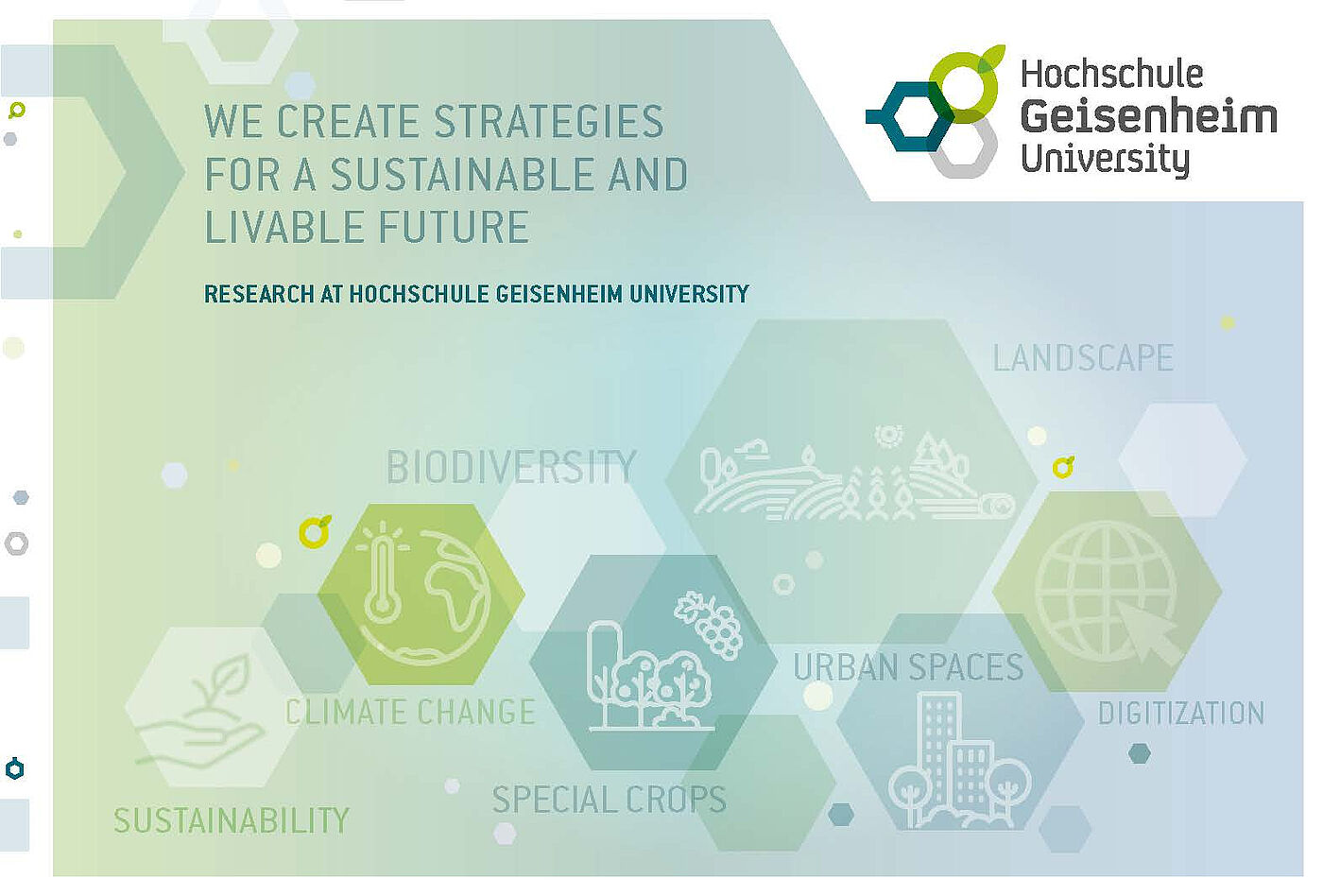
Creating Strategies for a Sustainable and Livable Future

Climate Change, Biodiversity Loss, Sustainability Targets – We're Meeting the Planet's Most Urgent Challenges

Our mission is to develop resource-efficient, innovative, and sustainable solutions in the area of agriculture and food. Our work spans a broad range of key issues: advancing organic, climate-resilient cultivation strategies for specialty crops, developing sustainable production and marketing methods, and designing livable cultural landscapes and urban regions. By uniting ecology, profitability, and a focus on quality of life, we aim to create a sustainable future in which society and nature can flourish together.

Our Focus Areas

Sustainable Cultivation Systems for Specialty Crops

Cultivating grapevines, fruit, vegetables, and ornamentals is particularly resource intensive – as such, a careful balance between producing the highest quality products possible and ensuring sustainable practices needs to be struck.

Through our research, we are developing innovative, ecofriendly strategies that ensure healthy harvests and preserve resources. We breed varieties and growth forms that are optimally adapted to climate change, environmental factors, and potential pests and pathogens. Modern sensor systems help control water and nutrient supply with pinpoint accuracy, alternative plant protection strategies – such as the use of antagonists – strengthen plants and their environments, and new digital techniques make precise management measures possible. Together with our partners, we are establishing diverse cultivation strategies that promote biodiversity and preserve ecosystem functions, creating an economically and ecologically sustainable future for viticulture and horticulture.

Innovative and Safe Processing and Marketing for Plant Products

Sustainability in food production spans the entire journey, from cultivation and processing to the moment the product reaches the customer. At every stage, product quality and safety needs to be guaranteed. The bioeconomy plays a key role in this context, enabling the more efficient use of resources, processes, and systems, while supporting the livelihood of the businesses that produce them. 

Through our research, we develop energy and resource-efficient methodologies for processing plant products and extracting valuable ingredients from crops and by-products. We examine microorganisms as natural protective cultures, evaluate the health effects of plant-based ingredients, and conduct sensory tests with our university panel. Market research, consumer behavior analyses, and industry data deliver essential insights for sustainable marketing strategies, particularly in the wine industry. We also analyze the logistical processes, from packing to distribution, and boost the efficiency and sustainability of the entire value chain with the help of modern, digital technologies.

Livable Cultural Landscapes and Urban Regions

Intensified land use has reduced valuable landscape features and biodiversity in many areas. Urban regions are also under pressure to maintain quality of life through green infrastructure such as parks and green belts.

Through our research, we develop methods to optimize and assess urban open spaces and enhance their social sustainability. We create techniques for greening sites with limited soil and for using plants in urban areas in a targeted manner, particularly in the context of climate change. For viticultural landscapes, we design strategies to adapt to climate change and preserve rare species. Additionally, we develop concepts for multifunctional, ecologically valuable, and attractive landscapes that enable new, sustainable production scenarios.

Questions about Our Research?

Please get in touch!

Christiane Jost
Dr. Christiane Jost
Building 5924
Room 01.01
Phone +49 6722 502 6334
Christiane.Jost(at)hs-gm.de Details

News & Latest Projects

European research for resource efficient vegetable production

[Translate to English:]
[Translate to English:]

EUVRIN meeting at Hochschule Geisenheim University connects irrigation and fertilisation research with agricultural practice


How can vegetable growers maintain reliable production under changing climatic conditions while using water and nutrients efficiently? This question was at the heart of the eighth annual meeting of the EUVRIN Fertilisation & Irrigation Working Group, held at Hochschule Geisenheim University from 22 to 24 September 2026. Around 30 researchers from more than ten European countries exchanged insights into current approaches to resource-efficient vegetable production. University President Prof. Dr. habil. Karl H. Mühling welcomed the international guests at the opening, together with Prof. Dr. Jana Zinkernagel, Professor of Vegetable Production at Hochschule Geisenheim University.


“To make vegetable production fit for the future, we need to consider irrigation, nutrient supply and soil health together. European collaboration and direct dialogue with growers help us test research approaches under different local conditions and develop solutions that work in practice,” said Prof. Dr. Jana Zinkernagel.


More precise use of water and nutrients


The scientific programme explored how digital tools and artificial intelligence can support irrigation management. Further contributions addressed the interaction between irrigation and nitrogen supply, cultivation in peat reduced growing media and strategies to reduce nitrate leaching. An interactive sensor workshop complemented the presentations with discussions on measurement technologies and their application in irrigation management.


Substrate reuse and circular approaches to fertilisation were also on the agenda. Geisenheim researchers Jongwon Kang and Saad Zafar contributed presentations on AI in precision irrigation and the use of reused substrates as alternative fertilisers in field grown onions, respectively. Related research at Geisenheim includes HydroSoilWise and UpgoeS: HydroSoilWise combines soil and water management to improve climate resilience, while UpgoeS investigates the reuse of organo-mineral substrate residues from hydroponic cultivation in field vegetable production.


Connecting research and practice


A field trip took participants to vegetable farms in Lampertheim and Mutterstadt and to a water supply and irrigation organisation in Schifferstadt. Discussions on site added growers’ perspectives to the scientific exchange. A tour of Geisenheim’s research facilities and an information session on European funding opportunities and EU-GIFT completed the programme.


The theme week brought together researchers, practitioners and the public to explore more sustainable food systems, with a particular focus on geographical identity and cultural heritage.


Further information: LinkedIn EUVRIN Working Group 

Photos: Philipp Stieffenhofer, Institut für Gemüsebau

Categories: Zentralredaktion, MyHGU-App, Mein-Netzwerk, Dashboard, HOCHSCHULE, Presse und Kommunikation, FORSCHUNG, Gemüsebau, Nachrichten

Images

[Translate to English:]
[Translate to English:]
[Translate to English:]
[Translate to English:]
[Translate to English:]
[Translate to English:]
[Translate to English:]
[Translate to English:]

Research brochure (click to enlarge)

Our University has unique opportunities to conduct scientifically recognized and applied research along the entire value chain of special crops. In doing so, we benefit both from a strong network of national and international partners and our own excellent research infrastructure at Geisenheim. Vice-President of Research Professor Annette Reineke