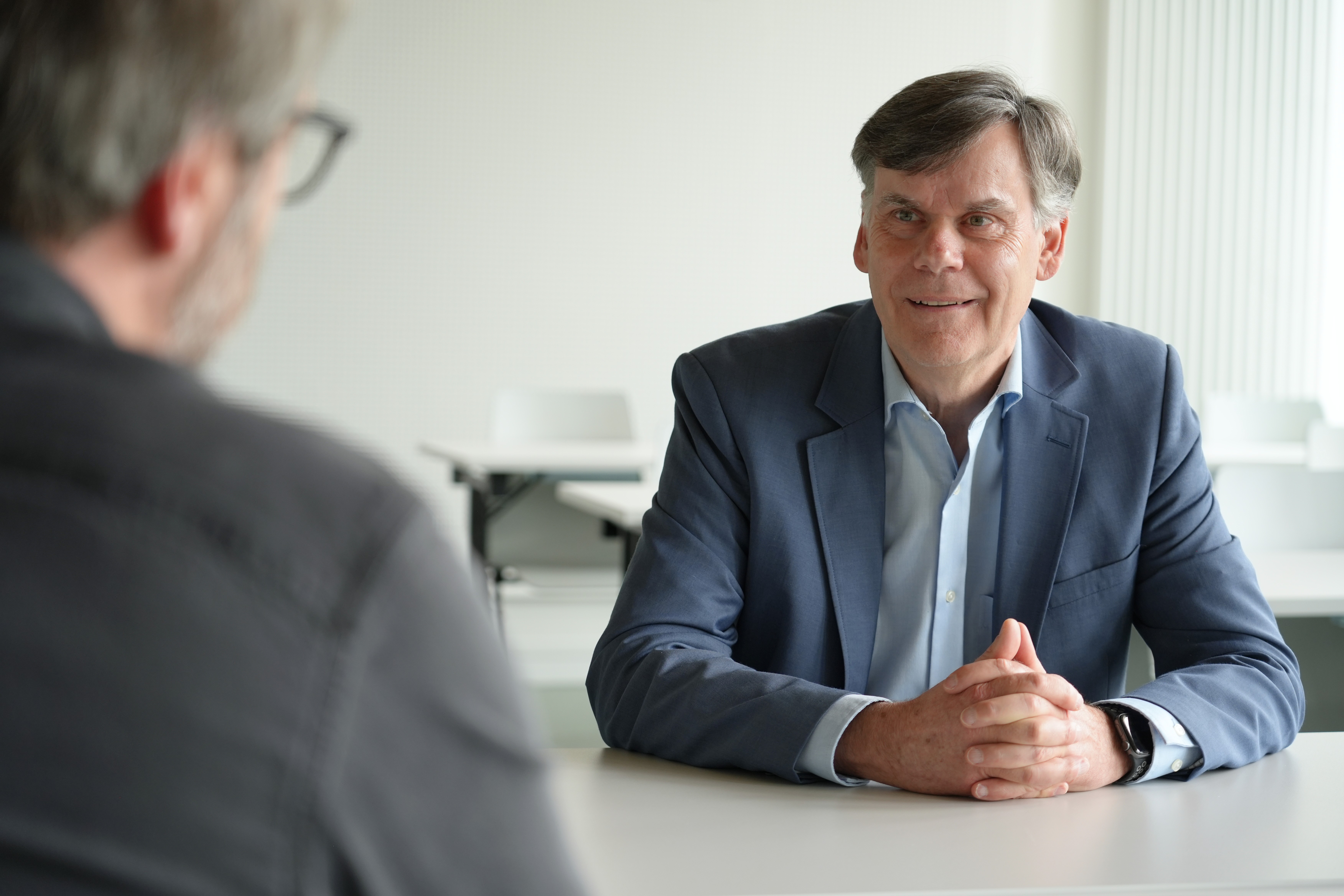
On June 1, 2026, Prof. Dr. Mühling took office as the new president of Hochschule Geisenheim University. A recognized agricultural scientist and academic manager, he has been associated with the university for many decades. In this interview, he discusses his career, his passion for research and teaching, his personal motivations, and his vision for the university.
Prof. Mühling, congratulations and all the best for your new role, and a warm welcome to Geisenheim! How long have you known the university and what do you think makes it special?
I have known the university for about 40 years now. I first heard about it back in the 1980s, when I was a student at Justus Liebig University, Giessen, because the two universities had a close cooperation. At first, I didn’t have any direct contact with Geisenheim because I wasn’t able to obtain the required university degree. However, I developed close ties with the university after I was appointed to a professorship because I had some Enology students from Geisenheim in my classes on Biochemistry and Biotechnology of Plant Production at Justus Liebig University, Giessen.
What inspires me most about Geisenheim is the special character of the university. By integrating basic and applied research, the university occupies a truly distinctive position in Germany's academic landscape. Its unique focus on special agricultural crops such as grapes, fruits, vegetables and ornamental plants truly sets it apart. At the same time, Geisenheim has expanded its scope to include food products, beverages and landscape architecture, which is remarkable and enhances its attractiveness and range of opportunities. This diverse portfolio is a unique selling point, offering significant potential for research, teaching, and knowledge transfer. In my view, this should be leveraged even more effectively in national and international marketing campaigns.
What did you do before you started your term of office in Geisenheim?
I studied agricultural science, earned my doctorate and became a professor before I worked at various research institutions for many years. In total, I have been working as a professor for 23 years – first at Justus Liebig University, Giessen, and then at Christian Albrechts University in Kiel.
One thing I really enjoy is teaching. I am particularly proud of the fact that during my academic career, I have supervised well over 100 bachelor's and master's theses, supported many doctoral students during their dissertation projects, and mentored several postdoctoral candidates. Many of my doctoral students have also won numerous doctoral awards, which is something I am very proud of.
Besides teaching, my heart has always been set on research, too. For example, I have conducted extensive research on nutrient use efficiency and strategies for reducing greenhouse gas emissions following the application of mineral and organic fertilizers. In addition, I have worked in the field of foliar fertilization, covering a wide variety of agricultural crops including vegetables and fruits. I have also conducted research in the area of stress resistance, specifically looking at ways to boost plants’ resilience to water stress (such as drought, salt stress and flooding) through tailored plant nutrition, to name just a few examples.
I think, research on plant resistance and quality is particularly fascinating in the context of climate change. After all, plant communities are truly adaptive systems that must be viewed through a systems science lens. Plants can teach us a great deal about the life sciences and that is exactly what research in Geisenheim is about.
What qualifications to you bring to your new position?
I have many years of international experience in science and university management, including several years working abroad and my involvement in three English-language master‘s programs. In addition, I have gained extensive leadership experience as dean and president of two academic societies.
Currently, I am president of the Dachverband Agrarforschung, the German umbrella organization for agricultural research, as well as publisher and editor-in-chief of two scientific journals. In this context, establishing close collaborations between academia, the professional community, and society at large is particularly important to me.
What are your ambitions as president? What do you want to do first? And what are your priorities for the first weeks in office?
Getting to know the staff and the departments is at the top of my list for the first few weeks. I believe that building trusting relationships with my colleagues and understanding the university are vital.
Another priority is to provide input to boost student numbers – especially at an international level. In this context, international master’s programs, such as Pomology, Vegetable Crops, Environmental Management or the trending topic of Plant-based Nutrition and Longevity – that is, factors contributing to a healthy and longer life – offer great potential. At the same time, I want to help strengthen the university as an attractive and state-of-the-art place to study.
As president, I believe one of my key tasks is to motivate the staff. Open communication, mutual trust, and working together to develop a clear vision for the university’s future are particularly important to me.
The academic world is changing, just as the many – mostly agricultural-related – industries, some of which are facing major challenges. Where do you see the university in five years?
In five years, I see the university as a leading institution with an even better international reputation for special crops, food, landscape and urban development, and with a strong focus on hands-on education. In times of major change, such as those posed by climate change, sustainability requirements and technological advances, Geisenheim can play a vital role as an innovative and reliable partner for research, businesses and society.
The special blend of scientific excellence, practical relevance and international focus provides a perfect foundation for this.
How would you describe yourself as a person? Do you have a personal motto?
I would say I am a curious and kind person with a good sense of humor. At the same time, perseverance is important to me – which is why one of my most important personal mottos is: Never give up.
And finally: What does a plant scientist like you do when you are not working? What is your favorite plant?
In my free time, I enjoy staying fit with activities like Nordic walking or cycling. I like to think of nature as my space to relax.
In terms of plants, I like all kinds of them. I am fascinated by plants from both a scientific and an emotional point of view. When I think of the emotional aspect, after many years in Kiel, I have come to love the fields of yellow rapeseed plants with the blue-shimmering sea in the background – this view is simply fantastic. To me, these landscapes offer a perfect blend of peace and openness and make me think of personal memories, such as my trips to the Baltic Sea. Now that I have started my new role in Geisenheim, I am sure I will be adding grapevines and fruit trees to that list of favorite plants soon. I have always loved the vineyards in this special Rheingau landscape.
Photos: Hochschule Geisenheim / Tina Kissinger, Philipp Stieffenhofer